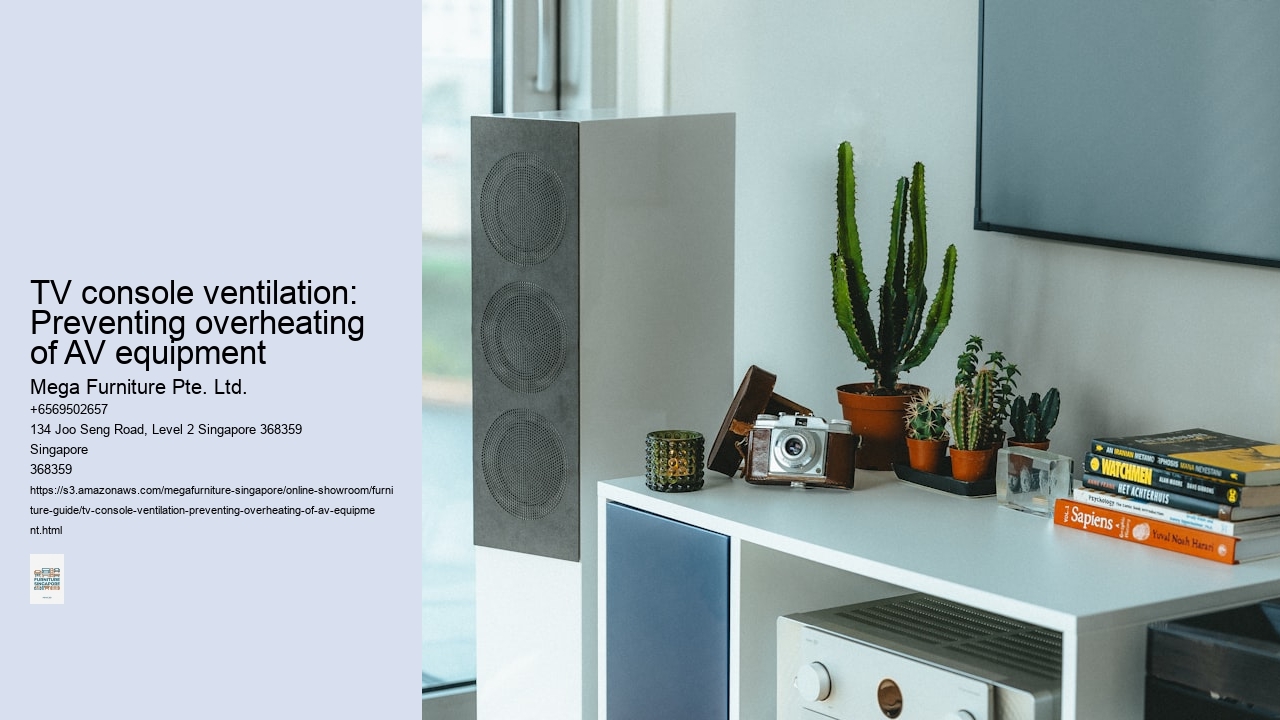
Ambient humidity in a typical four-room BTO flat can sit above 80% for weeks during the monsoon season, and that moisture accelerates component failure in ways heat alone doesn't. It's a quiet killer for electronics tucked away in enclosed cabinets. Many buyers assume rear cable grommets provide enough airflow, but those small holes are essentially useless for moving the volume of air needed; they're designed for cables, not cooling. For an AV receiver, PlayStation 5, or media player in a confined space, passive ventilation simply won't cut it.
You need active ventilation. That means looking for consoles with integrated, low-noise fans, or at the very least, perforated metal backs instead of solid panels. A perforated back panel, combined with a minimum 5cm clearance from the wall, allows hot, humid air to escape rather than recirculate. It's a detail often overlooked in showrooms, where everything is displayed in perfect, air-conditioned isolation — a far cry from the reality of a west-facing living room in Tampines after a rainy afternoon.
The consequences of ignoring this are cumulative. An AV receiver will throttle its performance, a media player's hard drive might fail prematurely, and a game console will sound like a jet engine. It's one of those functional considerations that separates a good console from a problematic one, especially for the longer 240cm units that house more gear. The design solution is straightforward: specify proper ventilation from the start.
Look for models that incorporate these features into their design, not as an afterthought. Some higher-end options use fine mesh or louvred doors at the sides to maintain a clean aesthetic while allowing air to pass through. It's worth paying attention to; a beautifully finished rubberwood console can still cook your electronics if it's sealed like a display cabinet. For a comprehensive range of options that consider these technical needs, you can browse Megafurniture's collection.
Ultimately, treating your console as part of your home's thermal management is just as important as its storage capacity or finish. That mild hum from a well-placed fan is far preferable to the silence of a dead amplifier.
That warped corner on a three-year-old TV console is almost always laminated particleboard that's reacted to Singapore's humidity. In many resale flats, where air-conditioning isn't running constantly, untreated boards swell and buckle, ruining the piece's alignment and appearance. Moisture-resistant treatments, often listed as 'green core' or 'E1 moisture-proof board', are a crucial upgrade for our climate. For a long-term investment in a 180cm floor-standing unit, solid rubberwood or oak offers superior stability, though you'll pay for it. The difference becomes obvious in a non-air-conditioned living room facing the afternoon sun.
Full-extension, soft-close drawer glides are the single best indicator of a console's underlying build quality. They allow you to see the entire contents of a deep drawer—essential for retrieving that specific HDMI cable or game controller from the back. The silent, dampened close prevents the rattling that echoes through a 4-room BTO flat at night. Cheap, side-mounted rollers feel gritty after a year of use and rarely support the weight of stacked game consoles. It's a detail that feels indulgent until you've lived with it, after which point there's no going back.
Open shelving isn't just for display; in a media console, it's critical for equipment ventilation. Tempered glass shelves are a common, stable choice that doesn't visually clutter the space, while powder-coated metal offers an industrial look and exceptional durability. Both materials aid airflow around an AV receiver or PlayStation, which can generate surprising heat in an enclosed space. Avoid solid wood or MDF for these shelves, as they block air circulation and can themselves be damaged by sustained heat exposure. This design choice directly impacts the longevity of the electronics you're storing.
Medium-density fibreboard, or MDF, should be strictly avoided in any unconditioned space like a service yard or in a console placed against a non-insulated exterior wall. It acts like a sponge in our humidity, leading to irreversible swelling and a musty smell that permeates the living area. Even painted or laminated finishes eventually fail as moisture seeps in through unseen seams or screw holes. For the structural carcass of a large, 240cm media wall unit, the risk simply isn't worth the lower upfront cost. Opt for treated particleboard or, better yet, plywood for these core components.
The quality of a console's finish—whether laminate, veneer, or paint—signals how it will age in a family living room. A good vinyl wrap should have tightly sealed edges with no visible bubbling or peeling, especially along the long front face. Painted finishes should feel smooth and hard, not soft or tacky, which indicates poor curing and a susceptibility to scratches from casual bumps. In high-traffic areas, a sintered stone or ceramic top can be a worthwhile upgrade over laminate for resisting cup rings and heat from decorative lamps. You're not just buying a colour; you're buying its resistance to daily life in a Tampines condo or Bedok HDB.
The most common error in a 4-room BTO living room isn't choosing the wrong colour—it's failing to account for the console's depth. Many buyers focus on length to fit a 65-inch TV, then discover a 45cm-deep unit blocks the walkway in a space under 3 metres wide. That leaves a cramped 60cm corridor between the sofa and console, turning a daily route into an obstacle course.
Glossy finishes, particularly high-gloss acrylic or lacquered MDF, are a persistent temptation for their sleek, modern look. In many homes, they're a mistake. They act like a fingerprint magnet, showing every smudge from curious toddlers and trapping a fine layer of dust that's visible from across the room. The reflective surface also highlights minor scratches over time, which means you'll be polishing it more than you admire it.
Ignoring cable management creates a hidden hazard. Tossing power strips, HDMI cables, and router wires into the back of the console results in a tangled, heat-trapping nest that restricts airflow around your media player and game console. That accumulated warmth is a primary cause of premature electronic failure, especially in our humid climate where heat dissipation is already a challenge.
Another frequent oversight is forgetting to measure the door frame. You might find the perfect 220cm console for your media wall, but if your main door clearance is only 80cm, delivery day becomes a logistical headache. Pivot-hinging a large, flat-packed box through a typical HDB doorway often requires disassembly on the spot—a dusty, frustrating process best avoided with a quick tape measure check beforehand.
It’s worth considering a floating console design or a wall-mounted variant in these narrow spaces; they visually open up the floor and make cleaning underneath far simpler. For those dealing with a plethora of devices, prioritising models with built-in cable ports and rear ventilation panels isn't just tidy—it's a practical necessity for protecting your gear.
The average 4-room BTO living room measures about 12 square metres, a space where every centimetre of a TV console’s profile counts. That’s where seeing furniture in a room-set configuration makes a tangible difference — you’re not just assessing a standalone unit, but understanding how its 180-centimetre length interacts with a three-seater sofa and an air-con ledge. Megafurniture’s showrooms in Joo Seng and Tampines build these precise scenarios, displaying their consoles against walls that mimic the exact constraints of local flats. It’s a practical advantage; you can immediately spot if a model’s depth will overwhelm a narrow walkway or if its floating design will clear a floor-cleaning robot. Local needs extend beyond mere dimensions into the technical demands of a modern media setup. A console packed with a gaming console, media player, and soundbar generates a surprising amount of heat, especially in our climate. Many of Megafurniture’s models address this directly with integrated rear ventilation panels and built-in wire management channels — features that prevent overheating and transform a tangled mess of cables into something you can actually hide. This functional forethought is something you’ll only appreciate by inspecting the units up close, running a hand along the internal cable cut-outs and checking the spacing at the back panel. Finish quality in photographs can be deceptive, promising a grainy wood veneer that arrives looking like laminated particle board. A visit lets you test the sturdiness of drawer glides and the true colour of an oak finish under showroom lighting, which is far more reliable than your phone screen’s rendition. You’re assessing whether the storage functionality works for your specific clutter: will those adjustable shelves accommodate a PlayStation 5, and do the drawers feel substantial enough for board games? It’s a tactile verification step that online shopping simply can’t provide. Committing to a large piece like a TV console is a significant decision for a Singaporean living room, often the anchor of the entire space. Seeing it first in a relevant configuration mitigates that risk, turning an abstract measurement into a lived-in visual. You leave knowing whether a 240-centimetre media wall unit will actually fit your space, or if a more compact design with clever storage better suits your
HDB layout.
The console you’ve chosen might not fit in the lift. That’s the first logistical hurdle many buyers in older HDB blocks or condos with narrow lift landings discover too late, especially for the longer 240cm units designed for 75-inch TVs. Confirm your building’s lift interior dimensions before ordering; a difference of just a few centimetres can mean a costly and complex staircase delivery, where movers have to navigate multiple flights in tight stairwells. It’s an added fee and a significant hassle, turning what should be a straightforward delivery into a half-day ordeal.
Once inside, assembly is the next critical phase. Professional assembly isn’t a luxury for wall-mounted or floating consoles—it’s a necessity. Many HDB and condo partition walls are drywall, and mounting a heavy, fully-loaded console onto them requires hitting the studs or using specialised hollow-wall anchors. A DIY attempt here often ends with a catastrophic pull-out, damaging both the wall and your new investment. A proper installer will assess your wall type and use the correct hardware, ensuring your media wall remains securely on the wall.
Your warranty terms matter just as much as the delivery details. Seek a minimum 12-month warranty that explicitly covers structural defects like joint failures or warping. Crucially, given Singapore’s perennial humidity, the warranty should mention coverage for humidity-related swelling or material degradation; a vague “manufacturing defects” clause might not protect you when that solid wood console panel starts to warp in your east-facing living room. A retailer confident in their product’s build quality for our climate will state this coverage clearly.
For comprehensive options that include detailed specifications and delivery advisories, you can browse Megafurniture’s collection. Their longer consoles, for instance, often come with clear notes on staircase delivery requirements, which saves you the guesswork.
Ultimately, the smoothest installation comes from treating the console as a built component, not just a piece of furniture. Factor in these logistics from the start, and you’ll avoid the common pitfalls that turn an upgrade into a headache.
The most common questions about TV consoles aren't about style—they're about the physics of fitting a 75-inch screen above a 200-centimetre cabinet, or the thermodynamics of a gaming console in a closed compartment. We gathered the real queries from buyers in showrooms and renovation forums.
Can a console hold a 65-inch TV on a 200-centimetre wall? Yes, but you'll get about 10 centimetres of overhang on each side, which is visually acceptable for most setups. The key is ensuring the console's top surface is deep enough to feel anchored; a 40-centimetre depth works, but 45 or 50 centimetres provides better visual weight. For a clean look, centre the TV on the console, not necessarily on the wall itself.
How do you cool an Xbox Series X in a closed cabinet? Use a USB-powered exhaust fan mounted at the rear. These are cheap, quiet, and plug directly into the console or TV; they create a low-pressure zone that pulls cooler air in from the front vents. It's a critical hack for BDB-built media walls where everything is meant to disappear behind a door—without it, you're just baking your electronics.
What's the best colour for resale value? Neutral oak or matt white. They're the default palette for HDB and condo living rooms, so they don't clash with a future buyer's existing sofa or feature wall. A dark walnut or bold colour might be your favourite today, but it becomes a negotiation point tomorrow; neutral finishes are treated as part of the architecture, not a personal statement.
Is a floating console safe for an earthquake? Seismic activity isn't applicable here, but the principle is the same: secure it to the studs. A fully loaded console can weigh over 100 kilograms, and drywall anchors won't hold that long-term. The risk isn't a tremor, but a toddler using it as a climbing frame—proper mounting into the concrete or timber studs is just non-negotiable for safety.
The most expensive TV console buyer can make is the wrong-sized one — it’s a mistake that sits against your living room wall for years, reminding you you rushed. Before you visit any showroom, tape out the console’s footprint on your floor. That’s the width your new 75-inch TV will demand, typically 180 to 240cm, and you need to see if it swallows the walkway to your kitchen or blocks the balcony door in your 4-room BTO layout.
Measure the wall, but also measure your gear. List every component: PlayStation 5, AV receiver, soundbar, maybe a NAS drive. Their combined heat output dictates ventilation needs more than any design preference. Prioritise rear grilles or open-back designs over fully sealed cabinets; a perforated metal back panel in a console from Megafurniture’s collection will quietly extend the life of your electronics, while a solid one might cook them within a year.
Verify delivery timelines against your renovation schedule, especially if you’re coordinating with contractors for built-in media walls in condos. A six-week lead time for a custom-finish console means you’ll need to stall your carpenter’s final trim work — mismatched schedules here leave you with a finished room and an empty wall for months.
Bring those room dimensions and photos to the showroom. A sales advisor can’t visualise your Eunos HDB’s odd corner from a description, but a photo of your existing setup, with cables spilling from a temporary table, lets them recommend specific solutions: a floating console to keep floor space clear, or one with integrated power strips to reduce clutter. That concrete advice turns a generic purchase into a fitted piece.
In a 4-room BTO flat, that sleek, low-slung cabinet is doing far more than just holding up the TV-it's a spatial negotiation. The fundamental choice here isn't just style; it's about defining the unit itself within the constraints of a 90 sqm floor plan or a resale flat's idiosyncratic layout. A console's length, for instance, isn't arbitrary-it's a direct response to screen size. Standard runs of 180cm, 200cm, and 240cm correspond neatly to 55”, 65”, and 75” televisions, a proportional relationship that keeps the living room from looking like an electronics showroom.
That leads to the first major fork in the road: wall-mounted versus floor-standing. A TV console anchors the wall opposite the sofa in the same way a tall bookshelf anchors a corner — long horizontal piece, mix of open and closed storage, defines the visual weight of one whole side of the room. Megafurniture's TV Console range covers floating wall-mounted designs, low-profile freestanding consoles, and modular feature-wall configurations. Most pieces sit at 40-50cm height, sized for screens up to 75 inches.. The wall-mounted variant, often floating 15 to 20cm off the ground, is a favourite for compact layouts; it visually lightens the room, creates an illusion of more floor space, and makes cleaning under it a non-issue. In many homes with young children or pets, however, the solid, grounded stability of a floor-standing console wins out-there's no worrying about a rambunctious collision shaking the entire media setup.
Concealed storage is the console's primary function, but it's also its biggest thermal liability. You're stuffing a PlayStation, an AV receiver, a set-top box, and a tangle of power bricks into a sealed wooden box, then wondering why everything overheats by 9pm. Effective design must account for this; look for models with strategic ventilation slats at the back, open cubbies amidst the closed doors, or even integrated cable management channels that allow heat to escape rather than pool.
Ultimately, the console you choose organises the living room's entire visual and functional centre. It dictates where cables run, where game controllers live, and whether that router's blinking lights become a nightly nuisance. For a curated range that addresses these fundamentals, from floating designs to substantial media units, you can browse Megafurniture's collection. Just remember, the right console doesn't just fit your TV-it cools your gear, survives your lifestyle, and finally tames that cord chaos behind the screen.
In a 4-room BTO flat, that sleek, low-slung cabinet is doing far more than just holding up the TV—it’s a spatial negotiation. The fundamental choice here isn’t just style; it’s about defining the unit itself within the constraints of a 90 sqm floor plan or a resale flat’s idiosyncratic layout. A console’s length, for instance, isn’t arbitrary—it’s a direct response to screen size. Standard runs of 180cm, 200cm, and 240cm correspond neatly to 55”, 65”, and 75” televisions, a proportional relationship that keeps the living room from looking like an electronics showroom.
That leads to the first major fork in the road: wall-mounted versus floor-standing. The wall-mounted variant, often floating 15 to 20cm off the ground, is a favourite for compact layouts; it visually lightens the room, creates an illusion of more floor space, and makes cleaning under it a non-issue. In many homes with young children or pets, however, the solid, grounded stability of a floor-standing console wins out—there’s no worrying about a rambunctious collision shaking the entire media setup.
Concealed storage is the console’s primary function, but it’s also its biggest thermal liability. You’re stuffing a PlayStation, an AV receiver, a set-top box, and a tangle of power bricks into a sealed wooden box, then wondering why everything overheats by 9pm. Effective design must account for this; look for models with strategic ventilation slats at the back, open cubbies amidst the closed doors, or even integrated cable management channels that allow heat to escape rather than pool.
Ultimately, the console you choose organises the living room’s entire visual and functional centre. It dictates where cables run, where game controllers live, and whether that router’s blinking lights become a nightly nuisance. For a curated range that addresses these fundamentals, from floating designs to substantial media units, you can browse Megafurniture’s collection. Just remember, the right console doesn’t just fit your TV—it cools your gear, survives your lifestyle, and finally tames that cord chaos behind the screen.